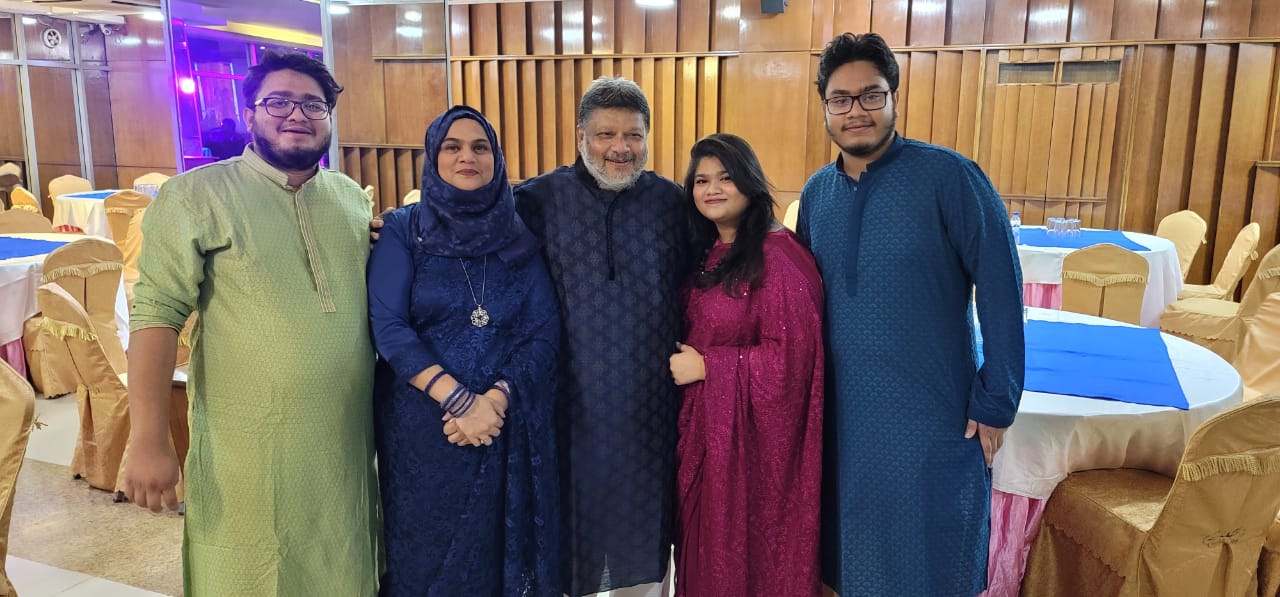
Photo: Mobarak (center), his wife Musarat, and his children spend time together as a family during Ramadan.
For Mobarak Ahmed, Venture37’s Finance and Operations manager based in Dhaka, Bangladesh, the month of Ramadan is a time for family. With three grown children attending college, he is lucky to spend just a few minutes with them a day. But during Ramadan, the entire family eat meals and pray together nearly every day.
For nearly 1.8 billion Muslims across the globe and the 130 million Muslims in Bangladesh, Ramadan is also a month of reflection. This reflection is meant to recognize bad habits, purify the mind and spirit, and commit to better habits in the future. It is not just about fasting. To help our global community better understand and appreciate how our staff around the world experience Ramadan, Mobarak is sharing a typical day in his life during this month.
3:00 a.m. - Mobarak starts his day early — earlier than most farmers. He wakes up this early to partake in sehri, a predawn meal. He and his two sons, daughter, wife, and mother eat a big meal that usually includes breads, milk, eggs, and sometimes rice and meat. It is a meal that must sustain them until sundown. After eating their sehri, Mobarak and his family spend additional time before dawn praying the Fajr prayer. In Islam, there is a belief that God is closest during these last moments of the night before dawn, so the Fajr is important and often practiced at the mosque. Because of COVID-19 restrictions, Mobarak is observing most prayers at home.
9:00 a.m. - During Ramadan, Mobarak and most of the Venture37 Bangladesh team start their workday later than usual, at around 9 or 10 a.m. In the office, Mobarak is business as usual (minus the food and water). Although this can be challenging, he believes it is important to uphold typical practices such as work and school. Unlike public prayer, fasting is between him and God, not a burden that needs to be shared with others. It is deeply personal and meant to be an honest reflection of his commitment to his faith.
5:00 p.m. - Once Mobarak finishes his workday, he rushes home to prepare for iftar. This is the meal eaten to break the fast at sundown, which is typically around 6:30 p.m. The Prophet Muhammad used to break his fast with dates, so many Muslims do the same, including Mobarak and his family. This is followed by a joyful meal with his entire family gathered nearby.
8:00 p.m. - At night, Mobarak opts to head to the mosque for the last of five obligatory prayers of the day, as well as a special Ramadan prayer called Taraweeh. This worship can take up to two hours because his imam (leader of the mosque), like many others, tries to finish the entire recitation of the Quran over the course of the month during the prayer. For Mobarak, this is a reminder of the foundations of his faith and family. Upon completion of the prayer, it is time to go home.
10:00 p.m. - Once he is home, Mobarak checks work e-mails (particularly to be responsive to his Venture37 colleagues in the U.S.) and goes to sleep around 11 p.m. or midnight to ensure a few hours of sleep before sehri comes again.
Ramadan is both a challenging and a beautiful month. And because it is based on the lunar calendar, it can fall during various times of the Gregorian calendar year — sometimes during the time of year when the days are extremely long. This month of sacrifice culminates in a colorful celebration of faith and family called Eid-al-Fitr. For Muslims, this day carries an equivalent importance to the Christian holiday Christmas or the Jewish holiday Yom Kippur.
For Mobarak, on Eid, each of his family members outfit themselves in new clothes to look their best. The day is filled with family, community, lots of special food, and fun. To ensure every person gets the opportunity to celebrate Eid, Mobarak, his family, and many other Muslims, make donations and contributions to their neighbors in need. Donations — or sadaqah — are considered a pillar of Ramadan and are particularly important on Eid.
Through this small window into Mobarak’s life during Ramadan, we hope that you better understand our team members’ practices during the month. On Eid — on or around May 13 this year, depending on when the moon sighting is — please reach out to your Muslim colleagues, including Mobarak, to say, “Eid Mubarak” (blessed festival)!
To everyone that observes Ramadan, we wish you a Ramadan Mubarak (blessed Ramadan)!